ISO/IEC 42001 Lead Implementer is an advanced course for professionals who want to plan, implement, manage, and continually improve an Artificial Intelligence Management System (AIMS) in accordance with ISO/IEC 42001. The course provides in-depth knowledge of AI governance, risk management, leadership responsibilities, and operational controls, and prepares participants to lead an organization through implementation and certification.
 Key takeaways
After successfully completing the training course, you will be able to:
 Prerequisites
Participants should have a basic understanding of management systems and governance concepts. Familiarity with AI, risk management, or information security is an advantage, but not a requirement.
 Target Audience
This course is designed for managers, consultants, auditors, compliance professionals, risk managers, and anyone responsible for AI governance, AI risk management, or implementation of management systems related to artificial intelligence.


The first day introduces the course objectives, structure, and the overall framework of ISO/IEC 42001. Participants gain an overview of relevant standards and regulatory frameworks related to artificial intelligence, and how these influence governance and compliance requirements.
The day continues with a detailed introduction to the Artificial Intelligence Management System, its structure, purpose, and role within an organization. Fundamental concepts and principles of artificial intelligence are covered to establish a common understanding of AI governance.
Participants also explore different approaches to implementing an AIMS, with a focus on leadership involvement, project approval, and decision-making structures. Roles and responsibilities within an AIMS are clarified, followed by practical exercises and knowledge consolidation to reinforce key concepts.
Day two focuses on planning the implementation of an Artificial Intelligence Management System. The day starts with a review of key learnings from the previous day before moving into an analysis of the organization and its context.
Participants work with defining the scope of the AIMS and analyzing existing management systems and processes. The course then covers the development of an AI policy and how this supports organizational objectives and governance requirements.
AI risk management is introduced in depth, including identification, analysis, and treatment of AI-related risks. The day concludes with the development of a Statement of Applicability and exercises designed to consolidate understanding of planning activities.
The third day is dedicated to the practical implementation of an AIMS. Participants learn how to select, design, and implement appropriate controls to address AI risks and governance requirements.
The course also covers the management of documented information and how documentation supports transparency, accountability, and audit readiness. A dedicated interactive session allows participants to apply concepts through exercises and discussions.
Further topics include communication, competence, and awareness, as well as the operational management of AI systems. The day concludes with exercises and knowledge consolidation to ensure understanding of implementation activities.
Focuses on monitoring, measurement, analysis, and evaluation of the Artificial Intelligence Management System. Participants learn how to conduct internal audits and management reviews to ensure ongoing effectiveness.
Handling nonconformities and driving continual improvement are covered in detail, followed by guidance on preparing for certification audits. The course concludes with final knowledge consolidation exercises, a full review of the course content, and closing reflections.
The fifth day is dedicated to the certification exam. Participants sit the ISO/IEC 42001 Lead Implementer examination and complete the course with a final wrap-up and closing of the training program.

After successfully completing the exam, you can apply for the credentials shown on the table below. You will receive a certificate once you comply with all the requirements related to the selected credential. For more information about ISO/IEC certifications and the PECB certification process, please refer to the Certification Rules and Policies.
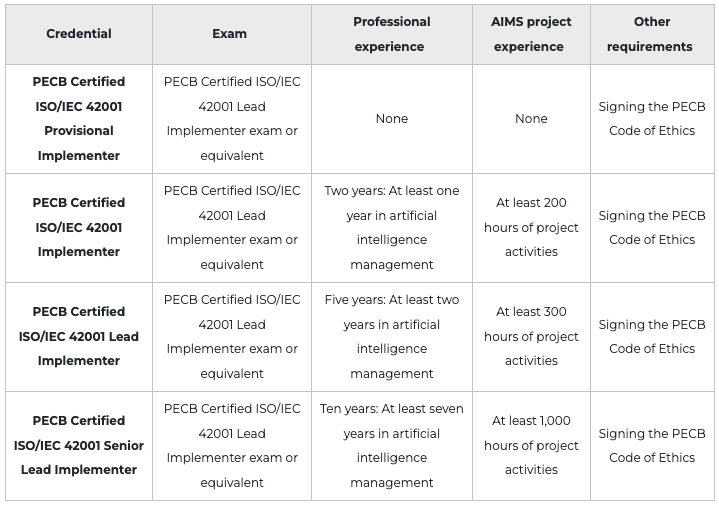
The exam is will take place at the end of the course on onsite classroom courses
For Virtual courses we will send out a voucher that gives you access to an online exam. This can be booked and taken home monitored by a proctor via camera. More information about the exam rules will be send from PECB.
As the exam is an Multiple Choice, candidates are authorized to use:
Examination rules and policies
Results will be communicated by email in a period of 6 to 8 weeks, after taking the exam. The results will not include the exact grade of the candidate, only a mention of pass or fail.
Candidates who successfully complete the examination will be able to apply for a certified scheme which is explained in the course description.
In the case of a failure, the results will be accompanied with the list of domains in which the candidate had failed to provide guidance for exams’ retake preparation.
Candidates, who disagree with the exam results, may file a complaint by writing to examination@pecb.com or through PECB ticketing system.
There is no limit on the number of times a candidate may retake an exam. However, there are some limitations in terms of allowed time-frame in between exam retakes, such as:
After the fourth attempt, a waiting period of 12 months from the last session date is required, in order for candidate to sit again for the same exam. Regular fee applies.
For the candidates that fail the exam in the 2nd retake, PECB recommends to attend an official training in order to be better prepared for the exam.
To arrange exam retakes (date, time, place, costs), the candidate needs to contact Glasspaper.

Hva er ISO/IEC 42001?
ISO/IEC 42001 er den internasjonale standarden for styringssystemer for kunstig intelligens, Artificial Intelligence Management Systems, AIMS. Standarden spesifiserer krav til styring, risikohåndtering og kontinuerlig forbedring for å sikre at AI-systemer er pålitelige, sikre og i tråd med virksomhetens mål.
Må jeg ha erfaring med AI for å ta dette kurset?
Nei, det kreves ikke tidligere erfaring med kunstig intelligens. Det er en fordel med noe bakgrunn innen styringssystemer, risiko eller governance, men kurset er utformet slik at du bygger forståelse fra grunnleggende konsepter til implementering og ledelse.
Hvordan registrerer jeg meg til eksamen?
Dersom eksamen er inkludert i kurset, håndteres registreringen gjennom kursdeltakelsen. Hvis du må registrere deg separat, kan dette gjøres ved å fylle ut registreringsskjema for eksamen og oppgi eventuell eksamensvoucher dersom du har mottatt dette.
Er det merverdiavgift på eksamen?
Sertifiseringseksamen er mva-pliktig. Eksamensprisen kan variere og håndteres i enkelte tilfeller separat fra kurset, spesielt dersom det gjelder eksterne vouchers.
Hvilken sertifisering får jeg?
Etter godkjent eksamen oppnår du PECB Certified ISO/IEC 42001 Provisional Implementer sertifiseringen. For å få full sertifisering kan det også stilles krav til dokumentert arbeidserfaring. Sjekk tabellen under sertifisering for mer informasjon.
Får jeg ISO-standaren?
Nei, men du får tilgang til en lånestandar som du kan bruke under kurset og eksamen.
Når mottar jeg kursbekreftelse og kursmateriell?
Du mottar normalt kursbekreftelse på e-post senest 48 timer etter påmelding. Tilgang til digitalt kursmateriell gis som regel i uken før kursstart.
Må jeg ta med noe til kurset?
Se kursbekreftelsen for detaljer. Dersom PC er nødvendig vil dette være oppgitt. Ellers vil kursmateriell normalt bli gjort tilgjengelig digitalt eller utdelt.
Hva skjer etter at jeg har bestått eksamen?
Du mottar sertifisering basert på bestått eksamen. I enkelte sertifiseringsordninger kan sertifiseringen være “provisional” inntil du dokumenterer tilstrekkelig relevant arbeidserfaring. Når erfaringskravene er oppfylt kan du oppgradere til full sertifisering.
Hvor lenge er sertifiseringen gyldig?
PECB-sertifiseringer er gyldige i tre år. For å opprettholde sertifiseringen må du dokumentere årlig aktivitet innen sertifiseringsområdet og betale årlig vedlikeholdsavgift.
Kan jeg få ekstra tid på eksamen?
Ja, kandidater som ikke har engelsk som morsmål får ofte ekstra tid i henhold til gjeldende eksamensregler. Det er også mulig å søke om ytterligere tilrettelegging via eget skjema for kandidater med særskilte behov.
Kan jeg ta dette kurset som e-læring eller selvstudium?
Ja, dette kurset tilbys også som e-læring. Påmelding kan registreres på høyre side.
Hva betyr “provisional certification”?
Provisional sertifisering betyr at du har bestått eksamen, men ennå ikke har dokumentert tilstrekkelig relevant arbeidserfaring for full sertifisering. Når erfaringskravene er dokumentert og godkjent kan sertifiseringen oppgraderes til full og tidsubegrenset sertifisering i henhold til Certification Rules and Policies.