Certified Lead AI Risk Manager is a professional training course designed to equip participants with the knowledge and skills needed to identify, assess, mitigate and manage risks associated with artificial intelligence (AI). The course covers both theoretical frameworks and practical applications, enabling organisations to adopt AI in a responsible, secure and compliant way.
AI systems introduce new types of risk — from ethical and fairness concerns to security vulnerabilities and compliance challenges under emerging regulatory regimes. This course provides a structured approach to AI risk governance based on recognised frameworks such as the NIST AI Risk Management Framework, the EU AI Act and real-world risk scenarios. Participants gain insights into AI risk identification, evaluation and treatment, and learn how to embed risk management practices into organisational processes for sustainable and safe AI adoption.
 Course objectives
Upon successful completion, participants will be able to:
 Prerequisites
Participants should have a fundamental understanding of AI concepts and a basic knowledge of risk management principles. Familiarity with AI governance frameworks such as the NIST AI Risk Management Framework or the EU AI Act is beneficial but not mandatory.
 Target audience
This course is suitable for professionals responsible for identifying, assessing or managing AI-related risks, including IT and security professionals, data scientists, AI developers, risk and compliance officers, consultants, legal and ethical advisors, and organisational leaders overseeing AI initiatives.


Participants are introduced to the fundamentals of AI risk — what it is, why it matters, and how it impacts organisations and decision-making. The session covers leading frameworks such as NIST AI Risk Management and the EU AI Act to provide a solid contextual base.
This section focuses on identifying risks across the AI lifecycle — from development and deployment to monitoring and decommissioning. Techniques for risk identification, categorisation and prioritisation are explored, helping participants understand how different risks can manifest in practice.
Participants learn how to design and implement mitigation strategies that address AI risks effectively. This includes establishing governance mechanisms, defining responsibilities and creating incident response and security controls aligned with organisational needs.
This part of the course covers how to monitor AI performance and risk controls over time. Participants learn how to report risk findings to stakeholders and integrate processes that support continual improvement of AI risk practices.
The course concludes with preparation for the certification exam, reviewing key learnings and providing guidance on what to expect for successful certification.

After successfully completing the exam, you can apply for the credentials shown on the table below. You will receive a certificate once you comply with all the requirements related to the selected credential. For more information about ISO/IEC 27001 certifications and the PECB certification process, please refer to the Certification Rules and Policies.
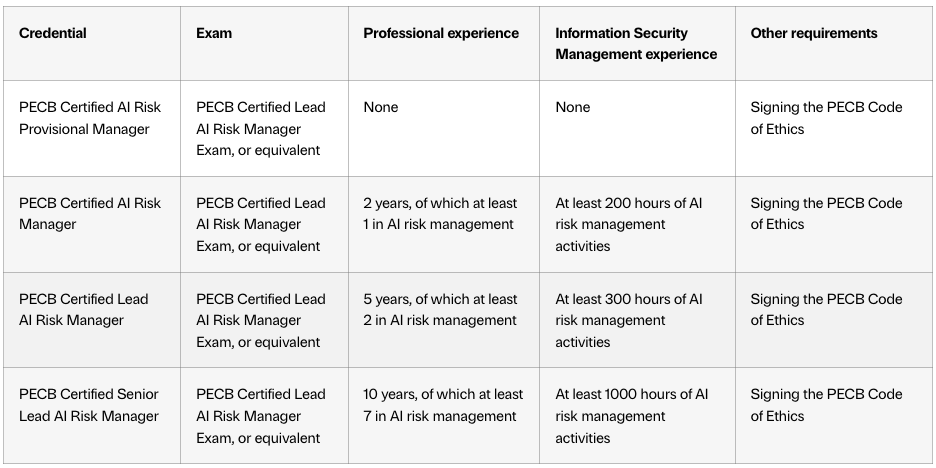
The exam is will take place at the end of the course on onsite classroom courses
For Virtual courses we will send out a voucher that gives you access to an online exam. This can be booked and taken home monitored by a proctor via camera. More information about the exam rules will be send fromPECB.
Test details:
As the exam is an Multiple Choice, candidates are authorized to use:
Examination rules and policies
Results will be communicated by email in a period of 6 to 8 weeks, after taking the exam. The results will not include the exact grade of the candidate, only a mention of pass or fail.
Candidates who successfully complete the examination will be able to apply for a certified scheme which is explained in the course description.
In the case of a failure, the results will be accompanied with the list of domains in which the candidate had failed to provide guidance for exams’ retake preparation.
Candidates, who disagree with the exam results, may file a complaint by writing to examination@pecb.com or through PECB ticketing system.
There is no limit on the number of times a candidate may retake an exam. However, there are some limitations in terms of allowed time-frame in between exam retakes, such as:
After the fourth attempt, a waiting period of 12 months from the last session date is required, in order for candidate to sit again for the same exam. Regular fee applies.
For the candidates that fail the exam in the 2nd retake, PECB recommends to attend an official training in order to be better prepared for the exam.
To arrange exam retakes (date, time, place, costs), the candidate needs to contact Glasspaper.

Duration: 5 days
Price: 27,900 NOK
Language: English
Format: Open course and corporate training
Hva lærer jeg på dette kurset?
Du lærer hvordan du identifiserer, vurderer, analyserer og håndterer risiko knyttet til AI, inkludert etiske problemstillinger, bias, sikkerhetsrisikoer og krav fra rammeverk som NIST AI Risk Framework og EU AI Act.
Hva kreves for å delta?
Det kreves grunnleggende kjennskap til AI-begreper og noen kunnskaper om risikostyring. Det er en fordel, men ikke påkrevd, å kjenne til AI-styringsrammeverk, som NIST lub EU AI Act.
Hvordan gjennomføres eksamen?
Eksamen tas vanligvis på slutten av kurset og kan gjennomføres enten fysisk på kursstedet eller online med voucher og online eksamensvakt.
Hva skjer hvis jeg ikke består første eksamen?
Du får normalt ett nytt eksamensforsøk, som gjennomføres online.
Får jeg ekstra tid på eksamen?
Du får ekstra tid dersom engelsk ikke er ditt morsmål, i tråd med sertifiseringsreglene.
Hvilken sertifisering får jeg?
Etter bestått eksamen får du PECB Certified AI Risk Provisional Manager sertifiseringen. Det finnes også videre grader innen AI risk sertifisering, avhengig av erfaring og kompetanse, se tabellen under sertifisering.
Får jeg ISO-standaren?
Nei, men du får tilgang til en lånestandar som du kan bruke under kurset og eksamen.
Hva er forskjellen på dette kurset og ISO/IEC 42001 Lead Implementer?
AI Risk Manager fokuserer spesifikt på risikoidentifikasjon, analyse og styring knyttet til AI-systemer, basert på rammeverk som NIST og EU AI Act. ISO/IEC 42001 Lead Implementer fokuserer mer på helheten i et AI Management System (AIMS) og standardbasert implementering i organisasjonen.
Kan jeg ta dette kurset som e-læring eller selvstudium?
Dette kurset er det kun mulig med selvstudie. Send oss en mail for mer infromasjon og påmelding: prosjekt@glassper.no